Who can act in time: leadership, staffing and authority behind critical controls
When a critical control fails, who has the authority, the competence and the time to act?
By Bruno Hounkpati, CEO and former VP HSERiskopilot Research, November 2026
In brief
When a critical control fails, the warning usually arrives. What is often missing is a named person with the authority, competence and time to act. This Riskopilot report gives executive committees, boards and site directors three instruments: a duty-coverage review of the busiest shift, two clocks that measure how long people stayed exposed, and seven decisions executives should sign for themselves.
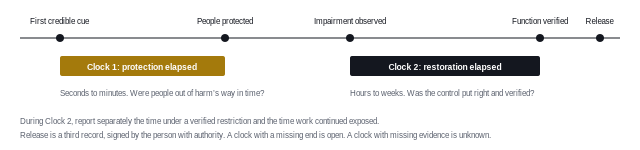
Two clocks, kept apart: time to protect people and time to restore the control.
Questions and answers
How many safety supervisors does a site need?
Research gives no ratio. The UK regulator's staffing method for process plants states that it is not designed to calculate a minimum or optimum number of staff. The report proposes mapping protective duties by interval on the busiest shift and checking that a qualified person with authority is free for each one.
What is a duty-coverage review?
A review that lists the protective duties a shift owes, cuts the shift at every change of task or place, and counts who is qualified and free in each interval, including travel time and deputies. It then chooses between added cover, resequencing, redesign, delegated authority and maintenance.
What is exposed time?
The time during which work continued with a critical control failed or its state unknown. The report separates it from time under a verified restriction and from repair time, using two clocks: one for protection and one for restoration.
Who should have authority to stop or restrict work?
A named person and a tested deputy for each critical control, with a trigger that does not depend on a completed diagnosis. In the 2018 Florida bridge collapse, investigators found that five parties could have stopped work or closed the road and none did.
Do leadership safety visits work?
A randomised study across 19 hospitals found that a senior-manager walk-round programme lowered staff ratings of improvement on average. Results were better where senior managers took responsibility for fixing the problems raised. The setting is hospitals and the outcome is perception.
Which decisions should executives reserve for themselves?
Seven: approving a budget cut, accelerating a schedule, extending an impairment, waiting for technical certainty, letting a contractor absorb the cost of a stop, buying more visibility, and accepting an administrative closure. Each should leave a one-page record naming the protective duty affected and who now covers it.
At a refinery in 2012, about 40 people worked at a leak for 2 hours 40 minutes before it ignited. The repair was not the problem. Nobody owned the decision to restrict.
After a serious event, the request is for more people or more cameras. Research offers no ratio to judge it by. A better question takes fifteen minutes of one morning to explain.