What an agent may decide: authority, evidence and limits for AI agents around critical controls
What may an AI agent decide where a critical control protects people?
By Bruno Hounkpati, CEO and former VP HSERiskopilot Research, November 2026
In brief
An AI agent can read records, compare them and warn a person faster than anyone on shift. It cannot be present at the workface, be competent in law or answer for a release. This Riskopilot report gives executive committees, boards and site directors a ladder of five rungs of authority, a nine-clause agent charter, a 90-day trial that tests the agent against plain fixed rules, and six decisions the executive committee should keep.
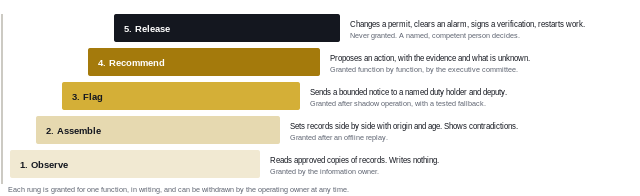
The ladder of agent authority: five rungs, and the one that is never granted.
Questions and answers
How much authority should an AI agent have in safety-critical operations?
The report proposes five rungs: observe, assemble, flag, recommend and release. Each is granted for one function, in writing, on its own proof. The fifth rung, which covers changing a permit, clearing an alarm, signing a verification or restarting work, is never granted. A named, competent person decides.
Does the EU AI Act require human oversight of AI agents?
For high-risk systems, Article 14 requires that people can understand the system's limits, stay aware of automation bias, override its output and stop it. Article 26 requires the deployer to assign oversight to people with the necessary competence, training and authority. Whether a given agent is high-risk is a legal question for each use.
When do the EU AI Act high-risk requirements apply?
Regulation (EU) 2026/1744, published on 24 July 2026, moved them to 2 December 2027 for the uses listed in Annex III and to 2 August 2028 for AI that is a safety component of a regulated product. The earlier dates were 2 August 2026 and 2 August 2027.
What is an agent charter?
A one-page grant with nine clauses: function, rung, sources, outputs, prohibitions, deadline and fallback, owners, change, and review and withdrawal. It names the person on each shift who can switch the agent off.
How should an AI agent be tested before it reads shift handovers?
Run the same frozen handovers through three arms: current manual review, fixed rules, and rules plus the agent. Two experts set the correct decision in advance. Eight challenge cases are injected, including a normal job where the right output is no notice.
How many test cases are enough?
A clean result on eight cases still allows a true miss rate of up to 31.2% at 95% confidence. Thirty clean cases allow 9.5% and sixty allow 4.9%. Eight cases are good for finding failures and poor for certifying their absence.
Can an AI agent justify reducing safety supervision?
Not on time saved alone. An agent only changes information-processing duties. Presence, competent judgement and authorisation are untouched. The report asks for a duty-coverage review on the busiest shift, replayed with the agent unavailable, before any post is reduced.
A supplier shows eight difficult handovers and the agent catches every problem. Before you sign, ask what a few plain rules would have caught, and what eight cases can prove.