
What your assurance system isn't telling you
The Bayesian, read from the boardroom
The owners were compliant. Seven people still died in a condition no document described.
The yacht Bayesian was classed, certified and compliant when it capsized off Sicily in under 15 seconds, killing seven of 22 aboard. The UK MAIB found the failure was not a broken rule but a condition its approved stability document never described — the angle at which the vessel would lose stability in its actual operating state, never calculated, never in the book. For a board, the lesson is not nautical. It is that approval is not assurance, and that the investigation methodology you mandate decides the conclusions you are allowed to hear. Two governance questions follow — and most boards have answered neither.
Strip away the superyacht and the headlines, and the Bayesian is a governance case. Here was an asset that had passed every gate a board relies on: classed by a recognised society, certified against the applicable code, operating with an approved stability document. By every artefact a director would point to, it was safe. Seven people died anyway — not because a rule was broken, but because the failure occurred in a condition no document had ever described.
"We were compliant" was precisely the owners' position. It is also, in almost every serious incident, the board's. Which is why the Bayesian is not a story about a boat. It is a story about the distance between what your assurance tells you and what is actually true.
Approved is not assured
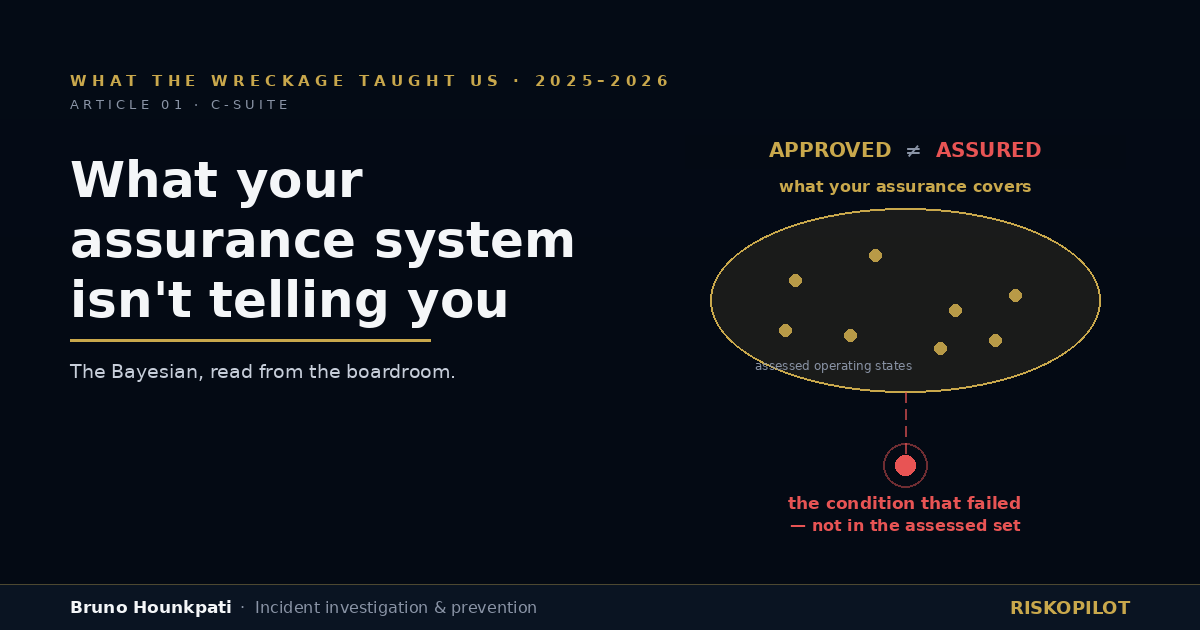
A board does not see hazards directly. It sees assurance: safety cases, audit reports, verification statements, certificates of compliance. Each of these is a promise that controls are in place and effective. But each is also bounded — valid only for the conditions it actually examined. The board's confidence is therefore only ever as wide as the conditions its assurance assessed.
On the Bayesian, the approved stability document carried the right safeguard — limits to prevent a sudden gust from flooding the vessel — but only for its sailing conditions. For the condition it was actually in that night, at anchor under engine, the document was silent. The stability limit there was later calculated at 70.6°, against the 84.3°–92.3° the document had certified for other states. The approval was entirely real. The assurance was partial. And no one knew which part was missing until seven people were dead.
Every assurance artefact your organisation holds was validated for a defined set of conditions. The conditions it never assessed do not show up as risks on any dashboard — they show up as nothing at all. At enterprise scale, these are the silent states a board carries without knowing it. The absence of a red flag is not the presence of safety.
Why your investigations keep telling you "human error"
If your internal investigations keep arriving at "operator error", the board is being systematically misinformed — and not by anyone lying. It is being misinformed by method. An investigation process built to identify who acted will reliably produce a person. An investigation process built to identify what conditions made the act inevitable will reliably produce a system. The same event yields either answer depending on which process you commissioned.
That is a governance fact, not a technical one. The board, or its delegate, mandates the investigation standard the organisation uses. So the board owns the blind spot its method creates. You cannot delegate the methodology and disown the conclusions it was built to reach.
"The sole objective of a safety investigation shall be the prevention of future accidents. It shall not be the purpose to determine liability nor to apportion blame."
The Bayesian shows this in public. Its safety investigation, barred by law from apportioning blame, reached a latent condition — an undocumented vulnerability in the operating state. The parallel criminal investigation, built to assign liability, has reportedly looked at the crew. A board that quietly runs a blame-oriented internal process is making the same choice as the prosecutor: it is choosing to see acts, and therefore choosing not to see its own latent conditions.
The methodology you mandate decides the conclusions you are allowed to hear. Commission a process that ends at a person, and you will be told about people — never about the conditions that will produce the next event.
The cost of an investigation that ends at a person
When an investigation closes on an individual, the latent condition that produced the event stays exactly where it was. The control is "retraining" or "a reminder"; the vulnerability is untouched. So the event recurs — and the second time, it carries the board's name, because the record now shows the organisation knew and acted only against the person. That is the sequence that converts an operational failure into a governance and liability failure.
The Bayesian's parallel proceedings make the exposure concrete: "operator error" and "systemic cause" are now competing in public, in the press and in court, over the same seven deaths. A board that has only ever been handed the "operator error" version of its own incidents has no defence prepared for the day the systemic version surfaces — because it never commissioned anyone to find it.
Three questions a board should ask
You do not need technical depth to govern this. You need three questions — usable in any assurance review, and mandatory after any serious incident.
- Which operating conditions has our assurance actually assessed — and which are silent? — Demand the list of operating states the asset actually runs in, mapped against what the safety case assessed. Red flag: management can describe the controls but cannot produce the list of unassessed conditions.
- What was our last serious investigation built to find — system conditions, or individual acts? — Audit the method, not just the report. Red flag: the recommendations are dominated by retraining, discipline and reminders, and no latent organisational condition is named.
- For every "human error" finding in the last 12 months, what latent condition remains in place? — Reopen the ones that ended at a person. Red flag: no one can answer, because the condition was never sought — which means it is still live, and still capable of producing the next event.
These three questions convert assurance from a comfort exercise — receiving confirmation that things are fine — into an oversight one: actively probing for the conditions no one assessed. That shift is the whole of the board's safety job.
Point to retain
A board's safety duty is not to receive assurance. It is to test what the assurance does not cover, and to insist on a method that reaches the system rather than a name. "Approved" is a statement about a set of conditions, not about reality. The conclusions you are willing to hear are the conclusions you have built the capacity to act on — and the latent condition you never asked about is the one that will arrive with your name attached.
"A board that only receives assurance is governing the conditions someone chose to assess — not the ones that will actually fail."
- Safety assurance
- — The arrangements — safety cases, audits, verification, certificates — that give a board confidence controls are in place and effective.
- Safety case
- — A structured argument, supported by evidence, that an asset's major hazards are controlled — valid only for the conditions it assessed.
- Latent condition
- — A decision, document or defect built into a system long before an incident, dormant until combined with a trigger (Reason, 1997).
- Active failure
- — An unsafe act at the point of an incident; the visible layer that a blame-oriented method stops at.
- No-blame investigation
- — An investigation whose sole purpose is prevention, explicitly separated from liability — engineered to surface system conditions.
- Silent state
- — An operating condition that exists in practice but was never assessed by the governing document; an un-assessed hazard, not a low one.
- Validated-condition scope
- — The set of conditions an assurance artefact was actually assessed for; conditions outside it are silent states.
- Management of change (MOC)
- — The formal process for assessing hazards introduced by any modification, re-rate or new operating mode.
- UK Marine Accident Investigation Branch (2025). Interim report: foundering of the yacht Bayesian. https://www.gov.uk/maib-reports
- US Chemical Safety Board (2025–2026). Incident Reports, Volumes 1–4. https://www.csb.gov/investigations/
- Reason, J. (1997). Managing the Risks of Organizational Accidents. Ashgate.
Frequently asked questions
This article is published by HSESKILLS Ltd for educational and informational purposes only. It is not legal advice. Composite scenarios illustrate common patterns and do not reference any specific organisation unless explicitly named.