
The control you counted that wasn't there
BASF Geismar, and the stop-work your board only thinks it has
Your people have stop-work authority. At BASF Geismar, someone used it — and the work continued.
On 1 October 2020, a contractor at BASF's Geismar, Louisiana plant used his stop-work authority on a visibly corroded chlorine valve. He raised it to a BASF employee; during escalation to a supervisor a miscommunication followed; the work continued; the valve failed, and a worker was hospitalised. For a board, the lesson is not "train people to speak up" — they did. It is that stop-work authority is a control the board designs, and its real strength is set by three choices most boards have never examined: the default when the answer is unclear, who can override a stop, and whether the authority is ever tested rather than assumed. A stop-work that dissolves in a handoff is not a frontline failure. It is a control you believed you had, counted in your assurance, and did not actually possess.
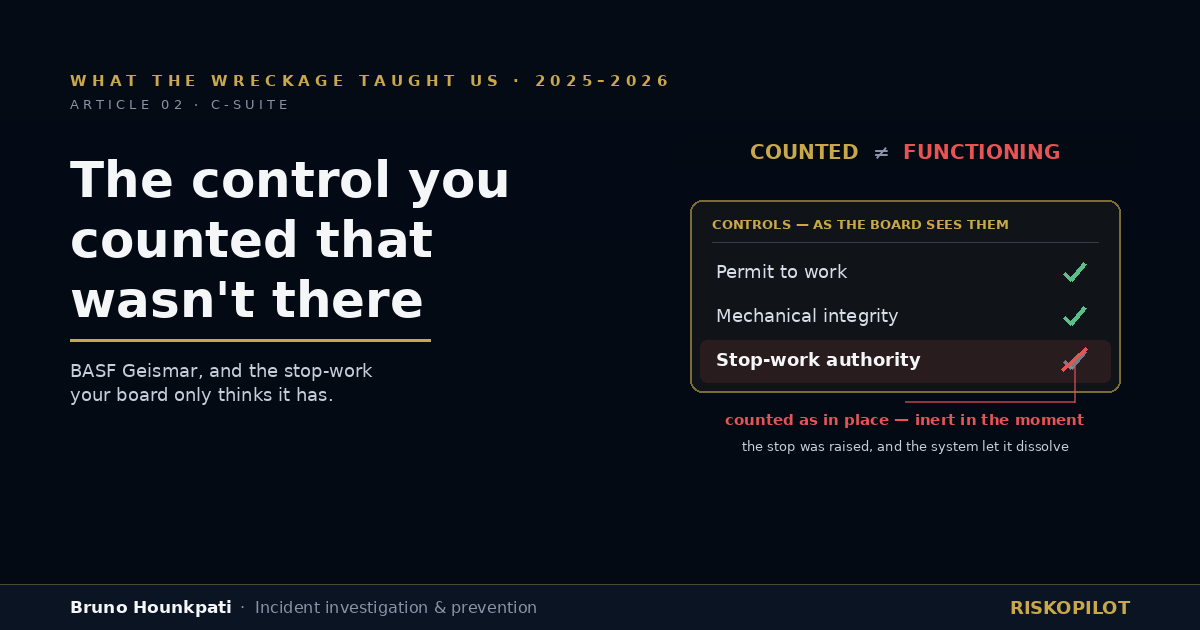
Most boards count stop-work authority among their safety controls. It appears in the safety case, in the contractor pre-qualifications, in the annual board safety report — a tick in the column that says the workforce can halt unsafe work. Geismar is the case that should make every director ask what that tick actually buys. A contractor used it. The work continued. The control was present in every document and inert in the only moment it was exercised.
This is not a frontline-behaviour story. The contractor did precisely what the programme asks: he saw a degraded valve and raised it. What failed was the system the organisation built around the moment he spoke. And a board owns system design — not the behaviour of the person at the valve.
A control you believe you have, and don't
The most dangerous category of risk for a board is not the hazard you have failed to identify. It is the control you have counted that does not function. The unidentified hazard at least leaves you alert. The counted-but-inert control does the opposite: you have allocated confidence to it, written it into your assurance, and stopped looking — precisely because you believe it is handled.
Stop-work authority is uniquely prone to this failure, because it is invisible until used and is almost never tested. At Geismar it existed in every artefact and failed in the single moment it was exercised. The board-level question was never "do we have stop-work authority?" It was "have we ever tested what our system does when someone actually uses it?" — and nobody had asked it.
A control that has never been tested under real conditions is not a control — it is an assumption wearing a control's name. Stop-work authority that has never been exercised and audited is the most common inert control on a board's risk register: fully documented, widely believed in, and entirely unproven until the day it is asked to work.
The board owns the default
Every stop-work system has a default: what happens, by inertia, while the answer is still being worked out. At Geismar, the default was "continue." That default is not chosen by the worker or the supervisor in the moment — it is set, in advance, by the system the organisation designed. Which is to say, by governance. When ambiguity routinely resolves toward "keep working," that is a board-level decision that was made implicitly, long before any valve started to leak — and it decides the outcome of every uncertain moment that follows.
The single most consequential safety parameter a board never explicitly sets is the default state of a stop-work — and in most organisations it is silently set to "continue."
The most dangerous seam is between organisations
The stop dissolved at a specific interface: a contractor raising a concern to a client's employee. That contractor–client boundary is where authority is most ambiguous, power most asymmetric, and accountability most diffuse — and it is exactly where boards apply the least design attention, because the contractor is "someone else's people." The seam between two organisations is the weakest point in almost every safety control, and stop-work is no exception.
And the exposure is not transferred with the work. When an incident happens at that seam, the contracting structure that looked like risk-transfer on paper becomes shared exposure in public and in court. A board that has outsourced the task has not outsourced the duty — it has only outsourced its own visibility into whether the control works. You remain answerable for a control you can no longer see.
"The most dangerous place in any operation is the line where one company's authority ends and another's begins. That line is written in the contract — not on the plant."
Three questions a board should ask about stop-work
You do not need to know the valve. You need to know whether the control you have counted actually functions. Three questions establish that.
- What is the default when a stop is raised and the answer is unclear — and who decided it? — If management cannot state the default instantly, it is "continue" — and no one chose it deliberately. Red flag: the answer describes the stop-work policy rather than the behaviour of the system while the decision is pending.
- Can anyone override a worker's — or a contractor's — stop without a positive, recorded restart decision? — If a stop can lapse through miscommunication or deference, it is a suggestion, not a control. Red flag: restart authority is informal or verbal, or sits with the party that has a schedule to protect.
- When did we last test what happens when someone uses stop-work — at the contractor interface specifically? — Red flag: the only evidence the control works is that it exists on paper and "people know they can stop." An untested stop-work at the contractor seam is the exact gap that produced Geismar.
These three convert stop-work authority from a line item the board accepts into a control the board has verified. That difference — between accepting and verifying — is the difference between Geismar and the near-miss that nobody outside the site ever hears about.
Point to retain
A board's job is not to remind people they can stop. It is to ensure that when someone does, the system stops — by default, without an argument, and regardless of who raised it or whose payroll they are on. A stop-work that has to survive a handoff to take effect is a control in name and a hope in practice. Geismar is what the distance between the two costs, measured in one hospital admission and three more corroded valves no one had yet found.
"A control you have counted but never tested is not protection — it is a liability you have already booked as an asset."
- Stop-work authority (SWA)
- — The right and obligation of any worker to halt work they believe is unsafe, without fear of reprisal; only a control if the system honours it by default.
- Safety-critical control
- — A barrier the organisation relies on to prevent or mitigate a major incident; its assurance depends on evidence it actually functions.
- The default state
- — What a stop-work system does by inertia while a decision is pending — "stop" or "continue"; set by design, not in the moment.
- Contractor–client interface
- — The organisational boundary where authority and accountability between a hiring company and its contractors become ambiguous; a frequent point of control failure.
- Control assurance
- — The evidence a board relies on that its safety-critical controls are in place and effective — not merely documented.
- Management of change (MOC)
- — The formal process for assessing hazards introduced by any modification, repair method or deviation from plan.
- Mechanical integrity (MI)
- — The programme ensuring critical equipment is inspected and maintained so it remains fit for service; a pre-job inspection at Geismar could have caught the corrosion.
- Latent condition
- — A decision or design built into a system long before an incident, dormant until combined with a trigger (Reason, 1997); a system's default is one of them.
- US Chemical Safety Board (2025). Incident Reports, Volume 2 — BASF Geismar, 1 October 2020. https://www.csb.gov/assets/1/6/incident_reports_volume_2_2025-03-12.pdf
- US Chemical Safety Board — Investigations and Incident Reports. https://www.csb.gov/investigations/
- Reason, J. (1997). Managing the Risks of Organizational Accidents. Ashgate.
Frequently asked questions
This article is published by HSESKILLS Ltd for educational and informational purposes only. It is not legal advice. Composite scenarios illustrate common patterns and do not reference any specific organisation unless explicitly named.