
The clean permit and the live line
Olin, PBF Martinez, and what your control-of-work record actually proves
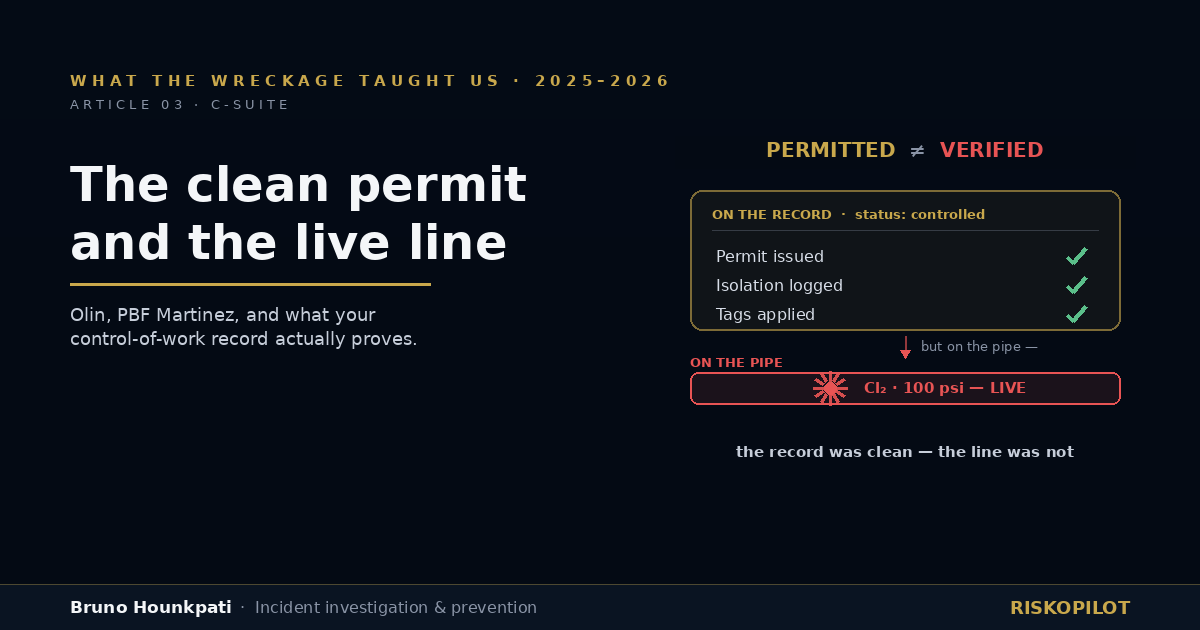
At Olin the permit was issued, the isolation logged, the job controlled. The chlorine was at 100 psi behind the disc anyway.
At Olin's Freeport plant in May 2025, a worker opened a chlorine line he believed was isolated; the isolation had been done on a nearly identical line, and about 8,000 pounds of chlorine escaped at 100 psi. Weeks earlier at PBF Martinez, contract workers opened a live hydrocarbon line and started a fire that cost an estimated $924 million. In both, the control-of-work paperwork existed and was in order. The CSB ties them — with the 2024 PEMEX fatalities — to one trend: ineffective systems governing the opening of equipment. For a board, the lesson is not "enforce the permit system." It is that a permit record proves a process was followed, not that a line is dead — and most boards accept the first as proof of the second. The question a board must answer is simple: does our control-of-work assurance measure paperwork compliance, or verified physical barriers? Those are different numbers, and only one of them keeps chlorine in the pipe.
Boards see control of work as a mature, audited system: permits issued, isolations logged, completion rates reported green. Olin and PBF are the cases that should make a board ask what those green numbers actually certify. In both, the paperwork was in order. In both, a worker opened a live line. The record and the reality had diverged — and the record was the thing the board was being shown.
This is not a story about a broken permit system. The system ran. What it could not do was guarantee that the physical line matched the paper — and that guarantee is the only thing that matters at the moment of break-in. A board that reads "permit compliance: on target" and hears "the work was safe" has made the same error the paperwork made: it has mistaken a record of intent for a state of the world.
A clean record is not a dead line
Assurance has a comfortable failure mode: measuring the process instead of the outcome. A permit issued, an isolation logged, a tag applied — each is real, auditable and reassuring. None of them is the same as the right valves shut on the right line, proven by a positive test. The record certifies that steps were taken. It does not certify that the stored energy is gone. The distance between those two statements is exactly where the chlorine was.
At Olin the record was clean and the line was live, because the isolation had been performed — correctly — on a nearly identical system. Every box was ticked. The boxes were on the wrong line. A board relying on completion metrics would have seen nothing wrong right up to the moment of the release, because by every measure it was tracking, the job was being done properly.
The gap between "the process was followed" and "the hazard is controlled" is where catastrophic incidents live. Process metrics measure the first. Only verification at the physical point of work measures the second. And boards are usually shown the first and told it is the second — a substitution that feels like assurance and functions like blindness.
The consequence is a board-level number, not a site-level one
The wrong-line mechanism does not produce small outcomes. At PBF Martinez it produced an estimated $924 million loss. At Olin it produced around 8,000 pounds of released chlorine and a community ordered to shelter in place. These are not lost-time-injury statistics; they are balance-sheet events, regulatory events and community-trust events — the categories a board is uniquely accountable for. The act is mundane: one worker, one flange, one wrong assumption. The exposure is existential.
A worker opening the wrong line is a site-level act with board-level consequences. The board cannot inspect the flange — but it owns the system that decides whether the flange is ever verified.
Unfamiliarity is a structure the board builds
At PBF the CSB's remedy was to have a knowledgeable person present to ensure unfamiliar workers opened the correct equipment. Read that as a governance statement: the company had arranged for work on hazardous equipment to be done by people who did not know it, without a knowledgeable person verifying. That arrangement is not a frontline choice. It is a product of contracting strategy, staffing models and turnaround planning — all board-visible decisions. Unfamiliarity at the flange is designed upstream, in rooms the worker never enters.
And the board's exposure here is direct. When contractors open the wrong line, the contracting structure that looked like efficiency becomes the proximate cause named in the investigation — and the duty does not transfer with the task. "Who knew this equipment, and were they there when it was opened?" is a question a board can ask without knowing a single valve, and the answer maps straight back to decisions the board itself signed off.
"The most dangerous number in a boardroom is a true one that measures the wrong thing."
Three questions a board should ask about control of work
You cannot verify the isolation. You can verify whether your assurance measures verification at all. Three questions establish that.
- Does our control-of-work reporting measure physical verification, or paperwork completion? — If the board only ever sees permit-compliance and closure rates, it is being shown that the process ran — not that any line was confirmed dead. Red flag: no metric distinguishes "isolation logged" from "isolation independently verified at the point of work."
- When unfamiliar workers open hazardous equipment, is a knowledgeable person required at break-in — and audited? — Red flag: this depends on informal judgment, or the contracting model routinely puts unfamiliar crews on hazardous break-ins without a knowledgeable person present — the exact arrangement the CSB faulted at PBF.
- Have we mapped where near-identical systems exist — and treated them as a named hazard? — Red flag: the organisation has no inventory of look-alike lines, and isolation verification does not specifically guard against the wrong-twin error that drove Olin. A hazard you have not named is a hazard you are not managing.
These three move the board from auditing whether the paperwork exists to auditing whether the paperwork corresponds to reality. After Olin, PBF and PEMEX, that distinction is not a refinement of oversight — it is the whole of it. The board that asks them is no longer relying on a record to tell it something a record cannot know.
Point to retain
The most dangerous assurance is the kind that is true and irrelevant. "The permit was issued" is true. "The isolation was logged" is true. Neither tells the board whether the line a worker is about to open is dead. The board's task is to insist its assurance measures the thing that keeps chlorine in the pipe — physical verification at the point of work — and to treat a clean record offered as proof of a safe line as exactly the error the wreckage keeps teaching. On the record is not on the pipe.
"A permit tells the board the process ran. Only verification tells the board the line is dead. Never confuse the receipt for the result."
- Control of work
- — The system of permits, isolations, approvals and verifications governing how hazardous work is planned, authorised and executed.
- Permit to work
- — A formal authorisation to perform defined work under stated controls; evidence the process was followed, not that the hazard is gone.
- Energy isolation
- — Placing equipment in a verified zero-energy state before work; the physical control a permit record is meant to reflect but does not guarantee.
- Control assurance
- — The evidence a board relies on that safety-critical controls are in place and effective — strongest when it measures verified barriers, weakest when it measures paperwork.
- Verification (vs validation)
- — Confirming, by physical test, that a control is actually in place on the actual equipment — distinct from documenting that a step was performed.
- Process safety
- — The discipline of preventing low-frequency, high-consequence releases of hazardous energy and materials — the risk class behind Olin and PBF.
- Latent condition
- — A decision or design built into a system long before an incident, dormant until a trigger activates it (Reason, 1997); an assurance that measures the wrong thing is one.
- Contractor management
- — The board-visible decisions — contracting strategy, staffing, turnaround planning — that determine who performs hazardous work and how their competence is assured.
- US Chemical Safety Board (2026). Incident Reports, Volume 4 — Olin Freeport (20 May 2025) and PBF Energy Martinez (1 Feb 2025). https://www.csb.gov/assets/1/6/incident_reports_volume_4_2026-02-18.pdf
- US Chemical Safety Board — Investigations and Incident Reports. https://www.csb.gov/investigations/
- Reason, J. (1997). Managing the Risks of Organizational Accidents. Ashgate.
Frequently asked questions
This article is published by HSESKILLS Ltd for educational and informational purposes only. It is not legal advice. Composite scenarios illustrate common patterns and do not reference any specific organisation unless explicitly named.