
The asset you couldn't control
Moss Landing, and governing a technology deployed faster than its failure could be contained
The plant was meant to anchor a clean-energy strategy. It became a total loss, an evacuation, and a liability — because it was scaled faster than its worst case could be contained.
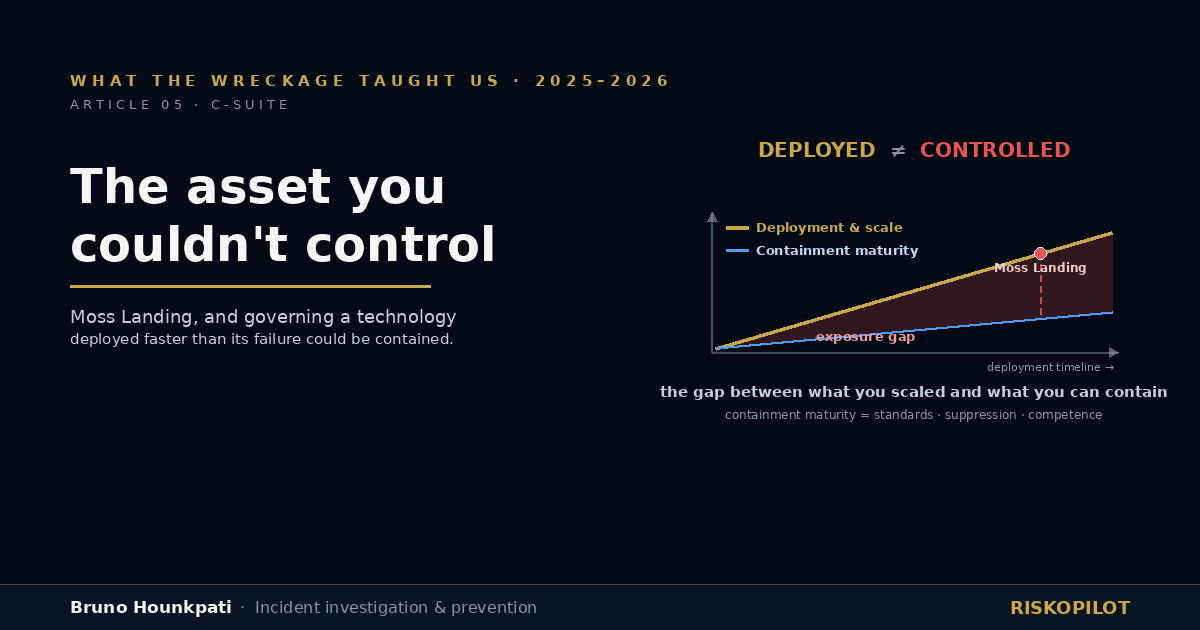
Moss Landing was meant to anchor a clean-energy strategy: one of the world's largest battery plants, a symbol of the pivot from gas to grid-scale storage. On 16 January 2025 its Phase 1 building entered thermal runaway and was a complete loss; more than 1,200 residents were evacuated, and the firefighters — who knew the site — could only watch it burn. The cause remains under investigation, but for a board the lesson is not the chemistry. It is that an organisation can deploy a technology faster than it can control that technology's failure. The plant was scaled to world-leading size in a repurposed 1950s building, ahead of the containment design, suppression and standards its worst case demanded. That is a governance fact, not an engineering one: deployment pace, not the battery, is what the board owns. The discipline this series has traced ends here, at its broadest form — never sanction scale you cannot yet contain.
When Vistra converted an old gas-plant site into one of the world's largest lithium-ion battery facilities, the plan was hailed as a clean-energy milestone — the kind of asset a strategy is built around. Phase 1 alone held enough storage to power hundreds of thousands of homes. Then, on a January afternoon, it caught fire, entered thermal runaway, and burned to a total loss. For the board, the meaningful question is not which cell failed or why — the cause is still being established. It is the prior decision: to deploy a novel, high-energy hazard at world-leading scale before the means to contain its worst case were in place.
The clearest image of the event is operational, but its meaning is governance. Firefighters who had toured and inspected the building could do nothing but monitor it as it burned, because a battery in full thermal runaway cannot be extinguished. That helplessness was not theirs to fix on the day. It was the visible expression of a decision made long before: the organisation had deployed this technology faster than it had built the ability to control its failure. When that is true, the worst day is not managed — it is merely survived, if you are fortunate.
You can deploy a technology faster than you can control it
With an established hazard, the means of control are mature and known. With a genuinely novel technology, they are not: the operator, the regulator, the insurer and the emergency services are all climbing the same learning curve at the same time. Meanwhile the commercial case — first-mover advantage, policy targets, capital already committed — pushes hard to deploy now and at scale. That is the structural tension, and only one body sits above the commercial urgency with a mandate to hold the line: the board. Deployment pace is therefore not an operational detail. It is a governance decision about how far ahead of demonstrated control the organisation is willing to run.
Moss Landing also shows how the decision usually gets made: on assurance rather than analysis. The batteries were housed in a repurposed 1950s building described in the project application as robust and non-combustible, with large numbers of high-energy racks in one open space, without the compartmentalisation newer modular designs use. Reporting describes the approving body being given assurances, not a worst-case analysis. One commissioner who had voted to approve later said, publicly, that she had been wrong. "Non-combustible" was a description, not a hazard study — and the gap between the two is exactly where a board must refuse to be comforted.
"It was a new technology" is offered as mitigation. For a board it is the opposite. Novelty is precisely the condition that demands more caution about scale, not less — because the controls, the standards and the experience are all immature at once. A worst case you cannot yet contain still has a magnitude: a total loss, an evacuation, a community and an environment exposed. Not knowing how to contain it is not the same as it being small. The unknown failure is the large one.
The numbers a board carries
The asset built to anchor the strategy became its opposite. Phase 1 was a complete loss of building and grid assets. Insured losses were estimated by Marsh McLennan at around 180 million dollars — among the largest battery-related property claims in U.S. history. More than 1,200 residents were evacuated and a major highway and local businesses closed. The smoke plume carried metals onto surrounding wetlands, with environmental testing and litigation following. And the regulatory response moved against the technology itself: the county advanced toward a moratorium on new battery projects, and a new state law now requires stronger containment, monitoring and engagement before such facilities open. A board that booked this asset at its build value was carrying a liability it had never priced.
An asset you cannot contain in its worst case is not worth its book value. It carries a liability you have not priced — and the day it fails, that liability is all that is left.
The learning curve is a governance boundary
The board's task with any novel high-consequence technology is to keep deployment pace inside the boundary of demonstrated control: a chemistry chosen for inherent safety, a firebreak through separation and containment, early detection protected, suppression matched to the failure mode, and a worst case engineered to be survivable. The standards now most associated with battery storage — NFPA 855 and UL 9540A — and the modular designs newer sites use, matured after Moss Landing was conceived. Deploying at this scale ahead of them was not bad luck. It was a choice about pace, and pace is the board's to set.
There is also a duty to the people who will manage the worst day. At Moss Landing the responders knew the building, but the standard playbook — water — did not apply to the hazard, and the surrounding community met the consequences without warning. The new state law's requirement for engagement with local fire officials before facilities open is, in governance terms, an admission that this should have been a precondition all along. A board should treat one question as part of any sanction: have the people who will manage the worst day already met this hazard — before the worst day?
"An organisation can be world-leading at deploying a technology and a novice at containing its failure. The board's task is to close that distance before scaling, not after."
Three questions before sanctioning a novel high-consequence technology
You will not understand every technology your organisation adopts. You can refuse to let its scale outrun your control of its failure. Three questions hold that line.
- Worst-case analysis, not vendor assurance, before sanction — Require a documented worst-case failure analysis — magnitude, containability, plume, financial and community exposure — before sanctioning a novel high-consequence deployment. Red flag: the case rests on assurances that something is "safe" or "non-combustible" rather than an analysis of what happens when it fails.
- Deployment pace inside demonstrated control — Confirm the means of containment — firebreak through separation, protected early detection, suppression matched to the failure mode — exist and are proven at the scale being deployed. Red flag: scale is set by the commercial case and capital committed, while the control measures are still maturing or unproven at that size.
- Responders and community briefed, worst case survivable, before commissioning — Confirm that local emergency services know the technology and that the worst case has been engineered to be survivable for people and neighbours — engagement now required by law where Moss Landing sits. Red flag: the first time responders and the community meet the hazard is on the day it fails.
None of these requires the board to understand battery chemistry, ventilation rates or fire codes. They require one refusal: not to let commercial pace carry the organisation past the point where it can contain what it has built. That refusal is the whole of the discipline this series has traced — across an assurance system, a counted control, a clean permit, a downgraded space, and now a scaled technology. The form changes; the boundary does not.
Point to retain
Moss Landing is this series' broadest warning. The latent condition was not a faulty part; it was a pace — deploying faster than the discipline to contain. As every business races to adopt new high-energy and high-consequence technologies, that is the board's enduring boundary: never sanction scale you cannot yet contain, and never accept assurance where the worst case demands analysis. A technology you have deployed faster than you can control is not yet an asset. It is an unpriced liability with a commissioning date — and, on the wrong day, a fire your people can only watch.
"Before you sanction scale, ask what the worst case costs and who has already rehearsed it. If the answer is "we are not sure," you have your answer."
- Thermal runaway
- — A self-sustaining chain reaction in a lithium-ion cell that cannot be extinguished with water once established — the failure mode the asset could not contain.
- Deployment pace
- — How fast and at what scale an organisation rolls out a technology; a board-level choice about how far ahead of demonstrated control it is willing to run.
- Demonstrated control
- — Containment that is proven to work at the scale being deployed — firebreak, detection, matched suppression — not merely intended or assumed.
- Worst-case analysis
- — A study of what happens when a technology fails at full scale — magnitude, containability and exposure — distinct from an assurance that it is safe.
- Compartmentalisation / modular design
- — Physically isolating units so a failure in one cannot spread — the firebreak newer containerised installations use and Moss Landing's open layout lacked.
- NFPA 855 / UL 9540A
- — The standards now central to battery-storage safety — installation and fire testing — which matured after Moss Landing was conceived.
- Stranded loss / liability
- — An asset that, instead of generating returns, becomes a write-off plus exposure (legal, regulatory, environmental) — what Moss Landing became.
- Latent condition
- — A decision built into a system long before an incident (Reason, 1997); here, a deployment pace that outran the means to contain the failure.
- WECC (2025). Moss Landing BESS Fire Report. https://www.wecc.org/
- County of Monterey (2025). Moss Landing Vistra Power Plant Fire — response and recovery. https://www.readymontereycounty.org/
- Aiello, I. W. et al. / San Jose State University Moss Landing Marine Laboratories (2025), via The Conversation — wetland heavy-metal fallout. https://theconversation.com/
- NFPA 855, Standard for the Installation of Stationary Energy Storage Systems; UL 9540A test method. https://www.nfpa.org/
Frequently asked questions
This article is published by HSESKILLS Ltd for educational and informational purposes only. It is not legal or financial advice. The cause of the Moss Landing fire remains under investigation; figures and details described as estimated, reported or preliminary reflect public reporting and may change. Composite scenarios illustrate common patterns and do not reference any specific organisation unless explicitly named.