Time to act: what technology can and cannot add to critical controls
What can safety technology add to a critical control, and what can it not?
By Bruno Hounkpati, CEO and former VP HSERiskopilot Research, November 2026
In brief
Published research shows that safety technology detects well. It does not show that it prevents serious accidents. This Riskopilot report gives executive committees and boards a five-gate investment test and six leadership conditions, so that someone has the time and the authority to act.
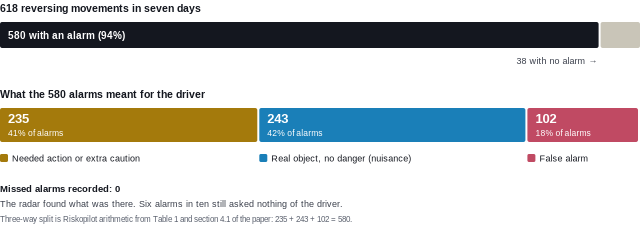
Outcome of 580 alarms in one published field audit of a proximity warning system.
Questions and answers
Does safety technology prevent fatal accidents?
Published studies do not show that it does. A 2023 mapping review kept 24 of 392 records and found low to no evidence of better working conditions or fewer injuries. The Cochrane review of construction injury prevention rates the evidence as very low quality. The report recommends testing specific functions on site before any rollout.
What is a nuisance alarm, and why does it matter?
It is an alarm triggered by a real object that poses no danger. In a NIOSH field study of one mining haul truck, the radar sounded on 580 of 618 reversing movements in seven days. 41% of alarms needed action or caution, 42% were nuisance alarms and 18% were false. No missed alarm was recorded.
What are the five gates before funding safety technology?
Can the exposure be removed? Which decision would the information change? Is there time to act? Can the site keep the system working? Does it beat the best conventional option? A "no" at any gate closes the technology case.
Who should hold stop-work authority?
For each fatal risk, one named person and one named deputy, reachable at any hour and with authority across every contractor. The investigations reviewed show that authority shared between several parties is exercised by none of them.
What should an executive committee ask for in the next 90 days?
A reconstruction of one failed critical control, every live technology proposal put through the five gates, the six leadership conditions tested, and at most one bounded pilot whose acceptance criteria are signed before testing.
A test for technology spending is easy to turn into a reason to do nothing. Five gates for executive committees and boards, and the clock that keeps them honest.
One haul truck, seven days, 580 alarms, zero misses. Most were dismissed as nuisance. They were the site telling its managers something the safety statistics could not.
Leaders are proud of stop-work authority. Six official investigations suggest it is a last resort, used when earlier decisions about authority, staffing and money have already gone wrong.